









Michael Benson, the incoming WVU president, has a solid academic background and brings energy and optimism to the job.

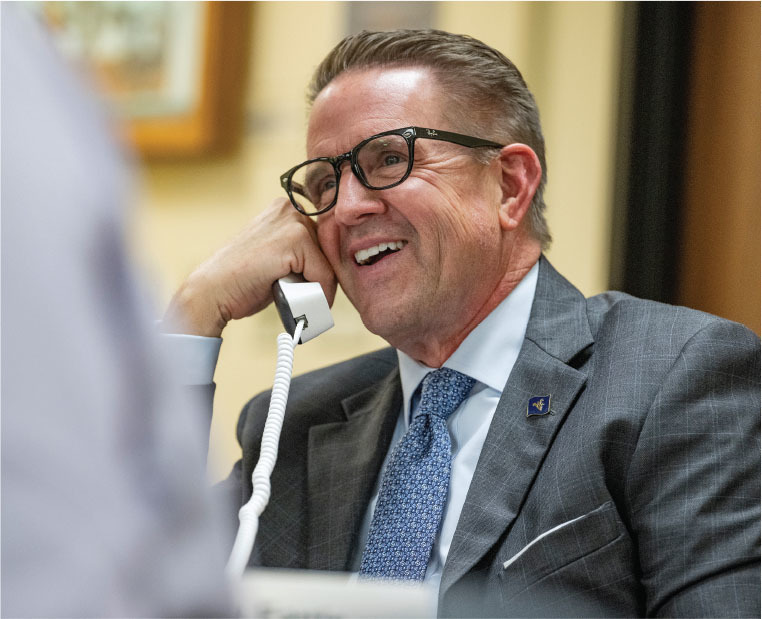
Michael Benson likes to talk with people—not at them. Our interview started with him asking to know a little about me. When he learned that, before my time at WV Living magazine, I’d written for the statewide weekly State Journal, he told me that he’s a subscriber. It was the first of many times in our conversation that he was surprisingly informed about and had already made connections with a state he’s never yet lived in but is clearly eager to experience.
Benson, you may know, is president at Coastal Carolina University in South Carolina and will replace E. Gordon Gee as president at West Virginia University this summer. It’s the fulfillment of several dreams for him, and it’s also a full-circle moment. He’s known Gee since he took the opportunity of a coincidence to introduce himself back when he started his first college presidency, at Snow College in Utah, in 2001. He happened to be 36, the same young age Utah-native Gee was when he was offered his first presidency at WVU, in 1981. “He was chancellor at Vanderbilt University at the time, and I called him and asked for advice,” Benson recalls. “In typical Gordon fashion, he said, ‘Do not make a 36 year old the president of anything!’ We stayed in touch, and he’s been a real friend and, in many ways, a big supporter and advocate.”

Academic Background
A searching mind has given Benson broad exposure to higher education. He has studied at Brigham Young, Notre Dame, and Johns Hopkins universities and holds a doctoral degree in modern history from the University of Oxford. His studies and research have taken him for significant periods to Italy and to Israel—he speaks Italian and has studied Hebrew and Arabic.
Benson followed his tenure at Snow College with presidencies at Southern Utah and Eastern Kentucky universities before arriving at Coastal Carolina in 2021. He has served in leadership in national-level higher education organizations. And he has written thoughtfully on the academic enterprise. His co-written 2018 book, College for the Commonwealth: A Case for Higher Education in American Democracy, argues that stronger colleges make for a stronger society. In Daniel Coit Gilman and the Birth of the American Research University, he shines a light on the transformational contributions of the research–teaching combination that has become a hallmark of the American university. That book was named one of the best higher education books of 2023 by Forbes magazine.
WVU’s Strengths
So, what about the position at WVU appealed to him?

“When I got my first presidency, my ultimate career objective was to be president of, one, an R1 university that focused on research; two, a school that played at the highest level of Division I athletics; and three, a school that has an academic medical center,” he says. Check, check, and check.
Benson is bullish about the university’s strengths. “WVU has a really unique position in a state that has some challenges related to outcomes in education, health, and civic participation,” he says. “We can be an example in so many ways of what a 21st century land grant institution looks like and the difference it can make.” He’s optimistic about the current course offerings and says he takes a forward view in terms of the research operation, the university’s service through extension, and the academic medical center.
He’s inspired by the reach of WVU Medicine—25 hospitals now, in four states—and the ability that gives it to improve the health of people across the region. He was impressed by his tour of the medical center and the people he met. Specifically mentioning Dr. Ali Rezai, the pioneering neurosurgeon who heads up the WVU Rockefeller Neuroscience Institute, he recalled the response Rezai gave in a 2024 episode of the CBS TV news magazine 60 Minutes when asked why such an eminent physician and scientist chose West Virginia. “He said something like, ‘I have a nimble team, they’re very capable, and we can get results quickly.’ I think that speaks to the vim and vigor of our health sciences operation, and I’d like to see that imbue the entire university—if we’re asked to do something, we’re going to do it and do it exceptionally well.”
Himself an athlete—he played basketball at both Brigham Young and Oxford—Benson is equally excited about WVU athletics. “We are, in effect, West Virginia’s sports teams,” he says. “You can argue 10 ways to Sunday that sports don’t matter, and we focus first and foremost on the academic mission, but fans associate the success of the state so much with how our teams do. That’s important as well.” He follows college sports closely and remarked on the Mountaineers’ two big March 15 wins: the NCAA Rifle National Championship and the women’s 3,000-meter event in the NCAA Indoor Track & Field Championships. He notes WVU’s No. 22 ranking in the fall 2024 Learfield Director’s Cup Division I Standings, based on overall success in NCAA championships. “That is just astonishing,” he says. “We are in a power conference, but our budget is considerably smaller than some of these larger schools—still, we get a lot out of what we invest. I have real confidence in our current coaches and athletic director and our commitment to excel and compete and do it the right way.”
The University’s Challenges
Benson considers himself an optimist. “I don’t disregard reality, but I’m much more comfortable saying, ‘This is a challenge, but we’re going to overcome it.’” He likes the 10/90 rule: “Life is 10% what happens and 90% how you react.”
That optimism shows up in his thinking about the university’s challenges. Asked about the downward trend in WVU enrollment—fall 2024 enrollment across the three campuses was down 5% from 2022 and 13% from 2019—he notes that it’s a challenge that colleges all over are facing. But, he says, the university can take steps to counter it. “WVU is a wonderful place with much to offer. Messaging is absolutely key: focusing on the outdoors, but also really selling students on the collegiate experience, the academic programs, the chance to come to a place that’s not so big that you’ll get lost—big, but small enough.” He recently suggested and participated in a call-a-thon in which members of WVU senior leadership each called a couple dozen high school students who had been accepted to WVU and hadn’t yet committed. “We had deans, vice presidents, directors all making these phone calls,” he says. He reached 15 students or parents directly through the evening. “It’s that kind of high-touch enrollment activity that I think will get us out of our slump. Applications are up, we’re very encouraged by that, and we’re going to focus on enrollment because it’s the lifeblood of the institution.”
Faculty and staff morale have been shaken by the Academic Transformation process that began in 2023 and ultimately cut more than 140 faculty positions and many dozens of staff positions as well as graduate math programs, multiple languages, and more. “I like to talk to people and hear their stories, and I get the impression that both staff and faculty need some attention,” Benson says on that topic. “I’m going to listen a lot, try and learn what their thoughts are on the future of the university, and we’re going to focus on our academic mission and what it means to be an R1 university.” As a teacher himself—he has an appointment in the history department and will teach a class—he is aware of the importance of the faculty and the challenges they face. “I want the faculty to know that, at his core, their president is a scholar, and I appreciate what they do.” He named several professors whose work has already come to his attention. “We have world-class faculty who need to become world-renowned faculty. Celebration of the faculty and their scholarly achievements is key. The president honors their role.”
Fundraising is always important, he says, even for a public institution. “The state is still our largest donor, if you want to look at it that way, and there are tuition and fees—but what sets you apart is the private giving.” Private donations to WVU amounted to a record $282 million last year, he noted. “And for a school our size, with as many alumni as we have, I’d argue that we need to be raising $300 million.” The university’s 2012–2017 State of Minds fundraising campaign raised more than $1.2 billion. A new campaign is in the early, quiet phase now. “I really enjoy raising money,” Benson says. “I hope I can go out with our development team and help close some deals.”
On Leading
The university may have some hard decisions ahead. When he’s faced with hard decisions, Benson says, he thinks about who will be affected and in what ways. “A trait that I try to emulate from leaders I admire is empathy: Put yourself in the place of your employees if you have to make a difficult decision, and have the long view in mind.”
To illustrate his point, he recounts his response in 2013 to the Eastern Kentucky University Board of Regents’ decision to outsource the grounds and custodial staff to address a looming budget shortfall. Benson didn’t feel good about the decision. “These were in some ways the most vulnerable of our employees, and they worked so hard to make the campus beautiful and keep it clean and presentable.” When the board persisted, Benson suggested the university offer those employees an education at no cost—something many would have found it hard to pay for. He remembers in particular a woman who cleaned his building and had a dream of one day becoming a state park ranger. She was able to earn a degree and, ultimately, landed a job at a Kentucky state park. “She wrote me the nicest note of appreciation for the fact that the university was willing to give her that chance.”
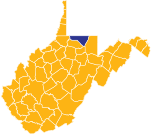
Benson currently lives in Myrtle Beach with his wife, Debi, and their children, Truman, Tatum, and Talmage. He has two older children from a previous marriage: Emma and Samuel. The family will remain in South Carolina for a year to smooth the children’s school transition. Benson will start work in Morgantown on July 15, but he’s already putting things in motion. “I’m optimistic about a strategic plan we’re working on that carves out a forward-thinking strategy for us.”
READ MORE ARTICLES FROM WV LIVING’S SUMMER 2025 ISSUE







Leave a Reply