









A story of mountains, mummies, and a university that’s changing the world.
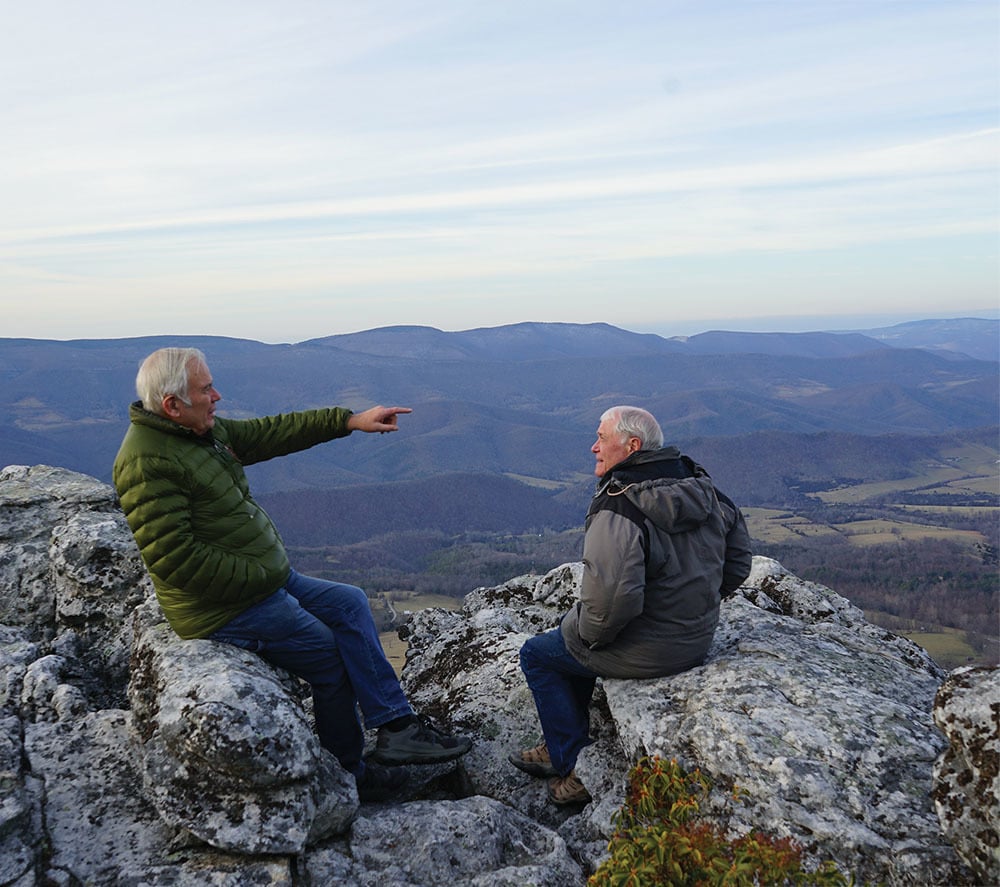
Let me tell you a story about a West Virginian who refuses to accept limits. Daniel C. Taylor has spent his life doing the impossible—turning ideas into action, mountains into sanctuaries, and struggling communities into thriving forces of change. He didn’t just study the world’s problems from afar; he climbed into them, walked alongside them, and built solutions from the ground up. He co-created the Woodlands Mountain Institute on the top of Spruce Knob, and from there his work led to the creation of the Qomolangma (Everest) National Nature Preserve—as in Mount Everest—protecting one of the most fragile ecosystems on Earth. In 2002, he founded Future Generations University in Pendleton County, a university unlike any other—one that few West Virginians have even heard of, yet its revolutionary model of education and sustainable development has shaped communities from Appalachia to the Himalayas.
And here’s where it gets even more interesting. Taylor is not alone in this quiet revolution happening in the misty ridges of the Mountain State, where the little-known university attracts some of the world’s most brilliant minds, renowned explorers, and accomplished conservationists. People like Johan Reinhard, a man who has literally spent his life uncovering lost civilizations at the top of the world as the planet’s most celebrated high-altitude archaeologist. He’s the explorer who discovered the Inca Ice Mummies in the Andes, including the Ice Maiden, the best-preserved example of a human sacrifice from the Inca Empire. Both of these men are part of The Explorers Club, an elite group that includes the likes of Jane Goodall, Sir Edmund Hillary, and Neil Armstrong. Their adventures have taken them to the farthest reaches of the Earth, yet it is in the rugged mountains of West Virginia that they have found home.

If you think this sounds like a script of an Indiana Jones movie, buckle your seatbelt. It only gets better.
Peak Curiosity
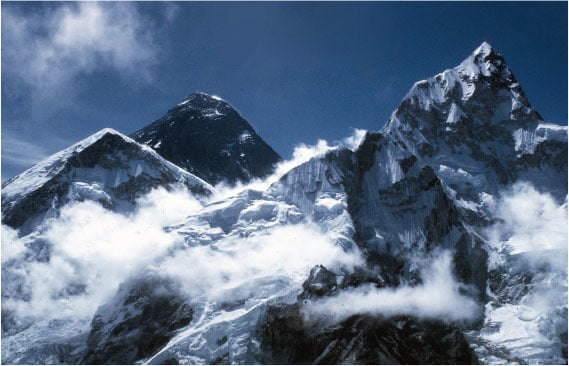
Daniel Taylor’s childhood was anything but ordinary. When he was just 2 years old, his family moved to India, where he spent much of his childhood until his father, Dr. Carl E. Taylor, took the family to Baltimore, Maryland, and founded the Department of International Health at Johns Hopkins University. But Taylor grew up in the shadows of the Himalayas, an immense, almost otherworldly range of snow-capped peaks that stretch across five countries: India, Nepal, Bhutan, China (Tibet), and Pakistan. They’re the highest mountains on Earth, home to Mount Everest, ancient Buddhist monasteries, Hindu temples, and centuries-old trails used by monks, nomads, and mountaineers alike. It was here that Taylor, at the age of 11, ventured into the dense forest and began an exploration that would span six decades—a quest to uncover the truth behind one of the world’s great mysteries: the legend of the Yeti. But more on that later.
Taylor attended Harvard, receiving his master’s in educational planning and a doctorate in development planning. “Then came the hard part. I had to figure out what I was going to do with my life,” he says. “It was 1972. I’d thought I’d go to Bangladesh and work on the population problem. A member of my doctoral committee said, ‘What happened to all your ideals?’ He called me a ‘colonialist,’ then asked, ‘What are you going to do in America?’”

That comment got Taylor thinking. “I had a history of adventure education. I reached out to a buddy from high school, King Seegar, who later became a pediatrician in Franklin, West Virginia, and with a couple hundred bucks, we leased 400 acres of land at the top of Spruce Knob that Marriott was trying to buy to put a resort and golf course on.”
Yeti or Not
Taylor could have chosen to live anywhere in the world, but he chose West Virginia. He recalls, “When we saw this land, we knew it was a very special place with fabulous outdoor recreational offerings—hundreds of caves, Seneca Rocks, which is the highest free-standing cliff east of the Mississippi, two branches of the Potomac River, and two million acres of national forest. We also knew we needed to be accessible. It’s a one-day drive from one-third of America’s population. And we loved the richness of the people. People here are not poor. They are rich, shaping lives around values. Especially their relationship to family and to the land—it was very important.”
He, Seegar, and a group of friends created a nonprofit conservation group that would focus on preserving mountain cultures and environments worldwide called Woodlands Whitewater, which became the Woodlands Mountain Institute and has now returned to its original mission as Experience Learning. “We built yurts on the property from timbers harvested from the land and began operating nature education programs,” says Taylor. “When I told my father what we were going to do, he said, ‘I like your gumption. I’m all for it. But you’d better learn how to do some fundraising. The best fundraiser I know is Milton Eisenhower, the president of Johns Hopkins and brother to U.S. President Eisenhower. Let’s see if he’ll give you some lessons.’”

Taylor credits that meeting with teaching him one of the most important lessons of his life. “When I met with him, he called in the director of development for Johns Hopkins, who told me, ‘If you want to raise money, you’ve got to get the time of the people you want money from. There’s a direct correlation between getting somebody’s time and getting their money. And the more effective you are at getting their time—getting them engaged with you in a personal relationship—the more money you’re going to get.’”
The two men encouraged him to start with the foundations serving West Virginia, but after researching, they realized there weren’t any foundations based in the state that were giving away serious amounts of money. They kept digging and then stumbled onto a small foundation based in Pittsburgh called The Claude Worthington Benedum Foundation that focused on West Virginia.
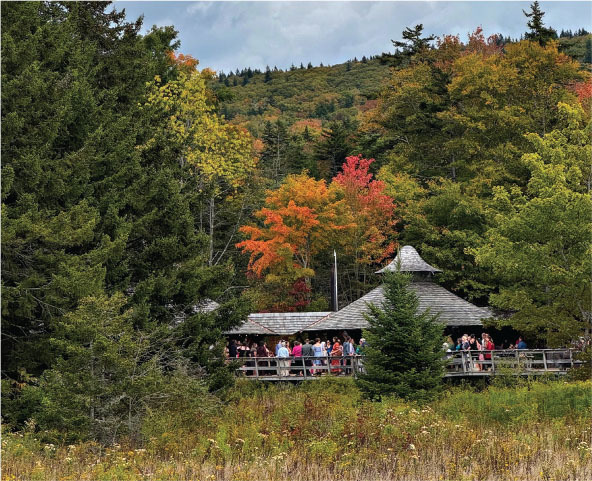
Taylor set out for the City of Steel. “I drove four hours from Baltimore, walked into the Benedum Foundation’s office, and asked to see Paul Jenkins, the president. I didn’t have an appointment, and he was in meetings. So I asked if I could just wait, which I did for quite a bit of time. Finally, Paul Jenkins comes out of his office and says, ‘I understand you want to see me.’ I said, ‘Well, Mr. Jenkins, I just wanted to meet you and to let you know that, in five years, I’m going to be asking you for a quarter million dollars.’”
Jenkins raised his eyebrows, but Taylor continued, “I’ll be here at least twice a year to give you an update, but please earmark a quarter million dollars, because we’re going to be buying some land at Spruce Knob.”
Jenkins smiled and responded, “Are you for real?”
And that began a relationship with the Benedum Foundation that would span decades. As promised, five years later, Taylor applied for a grant from the Benedum Foundation that would in essence provide for his first foray into land conservation, protecting West Virginia’s highest peak from commercial development. The Woodlands Mountain Institute became a pioneering force in innovative conservation programs, outdoor education initiatives, and community-based sustainable development projects.
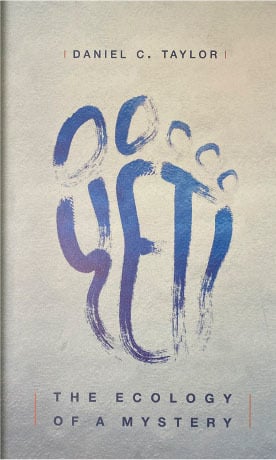
It was from here, West Virginia’s highest point, that Taylor returned to his lifelong passion project involving another pinnacle on the other side of the world—the search for the mysterious Yeti. “Myths do not make footprints,” he says. Determined to figure out what left the huge humanoid footprint discovered by Eric Shipton in 1951 that fueled global intrigue, he returned to the Himalayas in the 1980s, where, after several explorations, he discovered—SPOILER ALERT—that the footprints that were attributed to the Yeti were in fact made by the Asiatic black bear. “The Yeti is neither fully present in nature nor fully absent. Like a novel whose words may be fiction, it tells a story of true meaning,” he writes in his book, Yeti: The Ecology of a Mystery, published by Oxford University Press in 2017.
While that discovery may have been anticlimatic, what he uncovered in the shadows of Mount Everest was even more important. Deforestation, human activity, and climate change were threatening one of the most biodiverse and fragile ecosystems in the world. After an expedition to the remote Barun Valley at the base of Mount Makalu, Taylor was inspired to help the government of Nepal create a nature preserve to protect the area, which was teeming with rare wildlife and plant species like snow leopards, red pandas, and Himalayan black bears. He proposed the creation of a new type of national park—one that didn’t just protect the environment but also empowered the indigenous people who lived there. “There were a whole series of assumptions at the time about what a national park should look like. Should it look like Yellowstone, where there’s a perimeter around the park with a police force governing it?” says Taylor. “In America, we turned the U.S. cavalry into our National Park Service. Just look at their uniforms. Many groups thought you need a perimeter and you protect the perimeter with force. But that makes the local people feel ripped off. They think the land belongs to them. Conservationists mistakenly feel that it is necessary to take control. Listening to my neighbors who had farms inside the Monongahela National Forest, Harlan Judy and Adam Sponaugle, they told me how much better the forests and animals would be protected through partnerships with local communities. I took West Virginia national forest management experience to Mount Everest, and our team came up with another approach.”
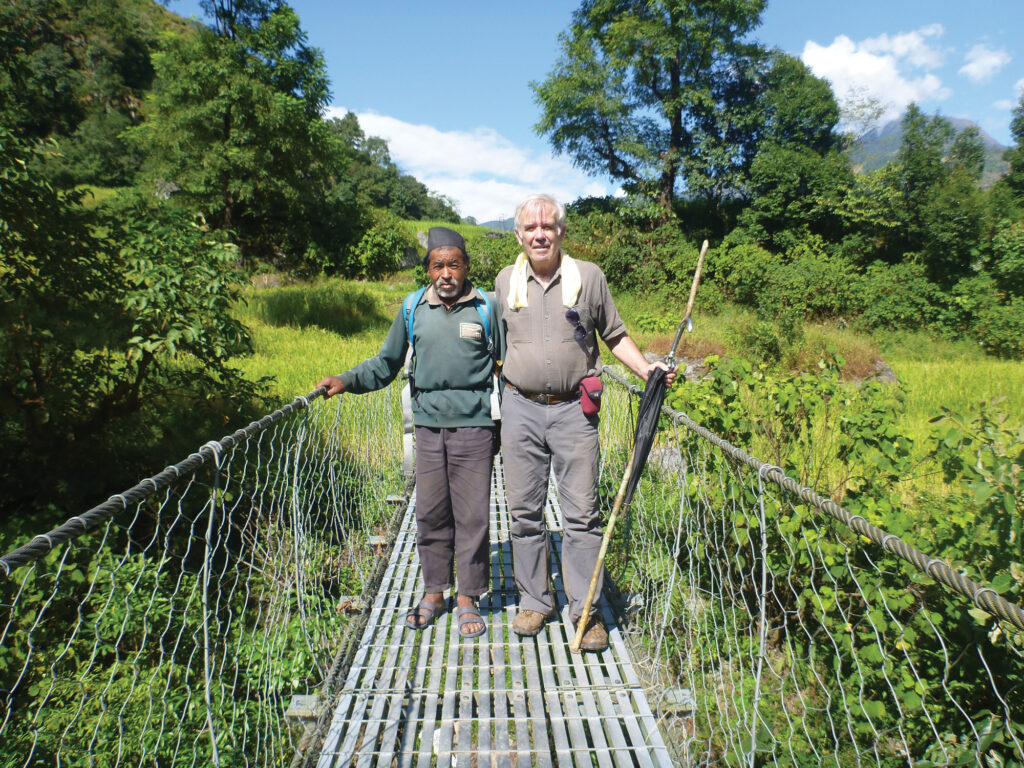
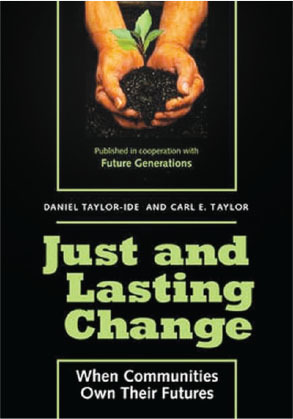
In 1992, the Government of Nepal officially established Makalu Barun National Park, making it the country’s first protected area to integrate local people into conservation efforts. It was also the year that Taylor left the Woodlands Mountain Institute to co-chair with his father a UNICEF task force to look at global evidence of sustainable community impact and how to grow it to scale. He chartered an organization called Future Generations to house the task force. From this work, he and his father synthesized the SEED-SCALE model, inspired by his work with community-centered conservation and his father’s work in health care, that questioned the system that focused on healing people instead of training people to not get sick. SEED-SCALE is considered to be one of their most significant intellectual contributions. It challenges conventional development approaches by empowering communities to lead their own transformations, relying on their own strengths. This approach has been so successful that it has been embraced in health care, environmental conservation, education, and conflict resolution worldwide.
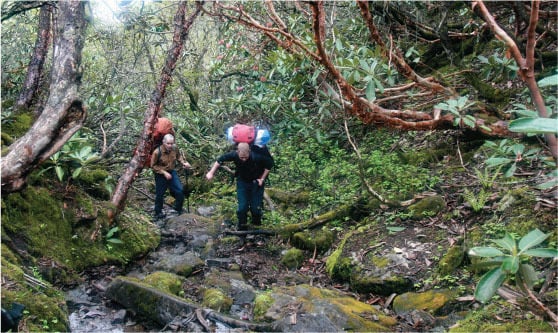
But Taylor didn’t stop there. He helped establish Qomolangma (Everest) National Nature Preserve in China’s Tibet, one of the largest and most significant high-altitude protected areas in the world, covering 13,050 square miles. Next was the 1,200-acre Lalu (Lhasa) Wetlands National Park behind the Potala Palace, followed by 40 million acres that protected one-seventh of China’s forest reserves, called the Four Great Rivers Nature Preserve.
“When exploring the Yangtze, Mekong, and Brahmaputra gorges—the last is four times deeper than the Grand Canyon—we counted 350 Chinese Army trucks a day carrying timber out of the area. These gorges were on the verge of an environmental crisis, with major implications for flooding downstream in China, so we approached the Chinese government by offering to create a land management plan so in a thousand years they could still get timber from the area. And it worked.”
The world took notice of Taylor’s transformative work. He became an adviser to the United Nations and was knighted by the king in Nepal. He was made the first honorary professor of quantitative ecology by the Chinese Academy of Sciences and decorated with the Order of the Golden Ark by Prince Bernhard of the Netherlands. But despite his international acclaim, he always returned home to West Virginia.
Mission Rooted in Mountains
After 10 years of proving that the SEED-SCALE approach worked, Taylor knew it was time to train more people and build the capacity of local leaders around the world. He had a vision: Higher education shouldn’t just teach theories about community development—it should actively create it. He had already developed SEED-SCALE, a model that flipped traditional development thinking on its head, proving that the most sustainable change comes from within communities, not from outside intervention. Now, he needed a university willing to teach others how to do it.
So he went to the big names—West Virginia University, Marshall University, Johns Hopkins—proposing a degree program that would turn students into real-world changemakers. They were interested. But there was a catch. “They loved the idea, especially since I had agreed to do the fundraising,” Taylor recalls. “But the percentage they would keep of the money I raised to cover administrative overhead was ridiculously high. I wasn’t trying to keep these universities in business. I was trying to improve the world.”
So he did what problem-solvers do. He built his own solution. He started researching how to create a university, following the West Virginia Higher Education Policy Commission’s Schedule 20. In short order, in 2002 Future Generations University was born, offering a master’s in applied community development. Full accreditation by the Higher Learning Commission quickly followed.
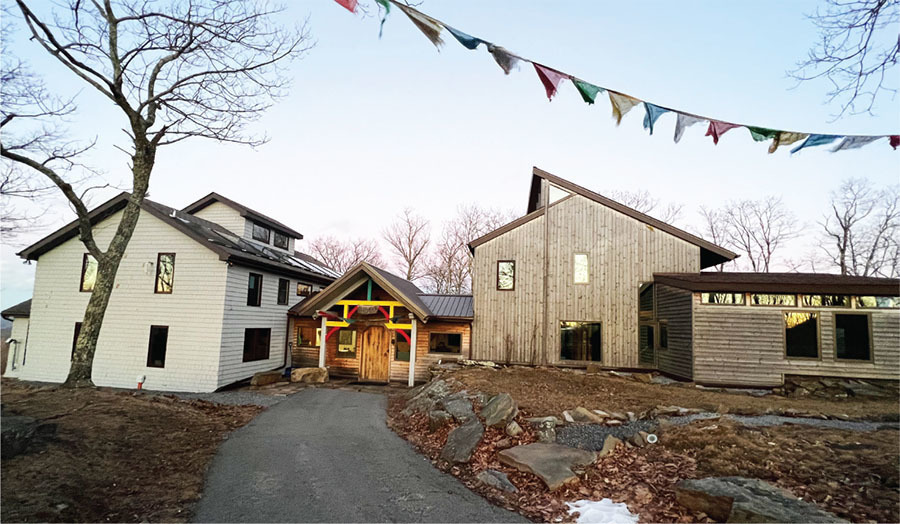
Taylor chose to headquarter Future Generations University in Franklin, West Virginia, perched on North Mountain overlooking Germany Valley and off a road appropriately named Road Less Travelled. But don’t be fooled by its rural location—its impact is global.
“We looked at our options. We either had to have a campus, which means you have to have a lot of money, build buildings, and take care of them, which is why roughly 60% of any university’s budgets goes into maintaining itself,” Taylor says. “Or we utilize the internet and embrace this new concept of online learning that allowed us to define the classroom in a different way from having classes inside computers. We took people to the best demonstrations of community development around the world, and they lived there in those communities. We knew it was going to be international from the beginning and have an online component that connected learning by students to their communities, wherever in the world that might be—and now that is to 54 countries.”
Most universities teach students how to leave. Future Generations University does the opposite. It teaches people how to stay—to lead, to build, and to transform their own communities using the strengths, culture, and wisdom that already exist there. There are no big lecture halls or burdensome administrative overhead. No one-size-fits-all curriculum. Students don’t learn abstract theories about change. They learn by doing—right where they live. A conservationist restoring a mountain ecosystem in Nepal. A public health worker creating grassroots medical programs in a remote village in Afghanistan. A West Virginia entrepreneur breathing new life into a struggling town. Each one learning, applying, and shaping their own communities in real time.
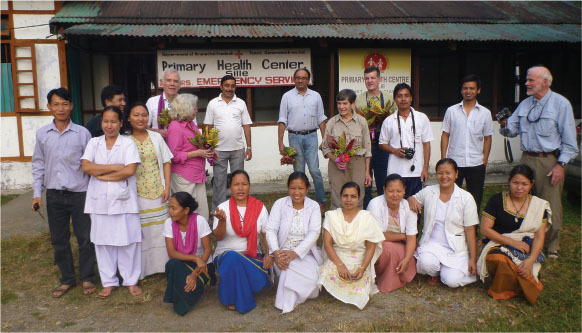
“This is not education as we know it. This is education as it should be,” says Taylor. “A system that doesn’t just produce graduates, but creates changemakers—people who don’t wait for solutions to arrive, but instead realize that the answers have been within them, and their communities, all along.”
Going Global
Future Generations University created a global network of sister organizations led by the university’s alumni in China, India, Afghanistan, and Haiti, where the university has been involved in transformative projects. One of their initiatives was the Green Long March. China’s rapid industrialization had fueled economic growth but left rivers polluted, forests stripped, and resources depleted. In 2007 through 2011, the university helped organize 10,000 Chinese university students each year to set out on a journey—not to fight a war, but to battle environmental destruction. Inspired by the historic Long March, the Green Long March sent students across the country to document pollution, deforestation, and water shortages while working with local communities on real solutions. Unlike traditional activism, these students didn’t protest; they planted trees, restored water sources, and helped communities develop conservation strategies. At its peak, the movement mobilized from more than 100 universities, creating China’s largest youth-led environmental network.
Future Generations University has also had a significant impact in Afghanistan, particularly in the areas of public health and women’s empowerment. Future Generations Afghanistan helped train hundreds of community health workers to deliver primary care in remote villages. By equipping locals with the knowledge to treat diseases, promote maternal and child health, and improve sanitation, they were able to reduce child mortality and improve health outcomes. “Mothers are the number one health care provider in the world, and homes are the number one health care facility. It’s not doctors and clinics,” says Taylor. “My father co-created Oral Rehydration Therapy and trained mothers how to reduce child death by learning low-cost salt-and-sugar solutions to treat childhood diarrhea, a major killer in developing countries.”
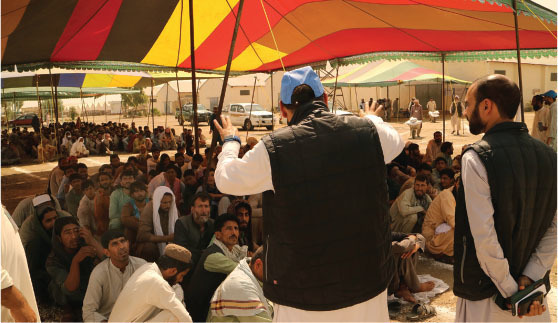
But Afghanistan is not an easy place to operate in, especially under Taliban rule. Taylor describes a late-night call with the university’s country director after the Taliban issued a sweeping edict to shut down all international organizations, branding them as spy operations. “We have a staff of 1,200 people. A $5 million annual budget. We’re feeding more than 30,000 people a day—three million people a month,” Taylor says. “When dealing with the Taliban, you can’t walk in with a human rights agenda and start making demands. You have to sit down, talk, and make sure they understand that three million people are going to be without food. Then as people wait in line for food, there is an opportunity to educate them on caring for their families.”
Closer to home, Future Generations University has applied this same community-driven model in West Virginia and the Appalachian region. The region’s history is defined by boom-and-bust industries—coal, timber, manufacturing. But this university sees opportunity in what remains: forests, culture, and a deep-rooted sense of place. Its Appalachian Program has helped communities expand agritourism, preserve cultural heritage, and reclaim their forests through sustainable forest farming. The university’s work in researching maple, walnut, and other tree syrups has helped expand production and markets for local producers. “The work of Dr. Mike Rechlin and my son, Luke Taylor-Ide, in our Appalachian Program is exciting. They are using SEED-SCALE to help support regenerative agriculture and food systems across the state. Instead of taking a traditional approach that focuses on needs or problems, Luke’s work is focused on finding local community successes that can be adapted by other Appalachian communities. This is the magic of SEED-SCALE: It doesn’t try to fix problems; it focuses on what solutions are already working and then uses evidence to create partnerships that let these successes grow on their own. West Virginians have the answers that will help West Virginia when we work together for the future.”
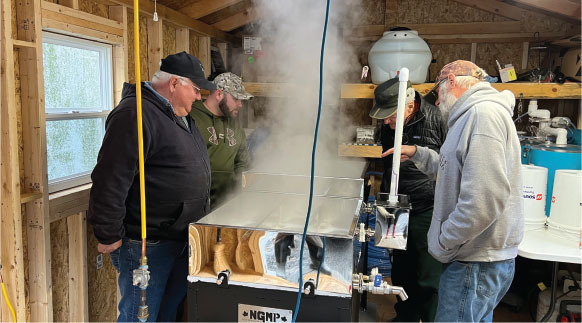
This kind of work isn’t flashy. It often doesn’t make headlines. But it changes lives. That’s why Future Generations University has worked relentlessly to keep tuition low. “The students we really want can’t afford to pay,” Taylor admits. “So we fundraise. A lot.”
And they have a compelling story to tell. “Some of our graduates’ stories will make you cry,” says Taylor. “People like Chido Madiwa, who ran for parliament in Zimbabwe and fought for mandatory sentencing for rape and equal rights for women in banking,” says Taylor. “Nawang Gurung, who has mobilized community health workers in Nepal. Or Louina Robillard, working in the slums of Haiti. Or James Patterson, who has rallied African American churches in West Virginia to help tackle the addiction crisis.”
Trailblazing Team
Through its work around the globe, Future Generations University has been able to attract acclaimed trailblazers as instructors and researchers—rock stars in their fields. People like National Geographic Explorer, archeologist, and cultural anthropologist Johan Reinhard. If you don’t recognize his name, you should. Few archaeological discoveries have captivated the world like the Inca Ice Mummies, and he’s the man who found them.
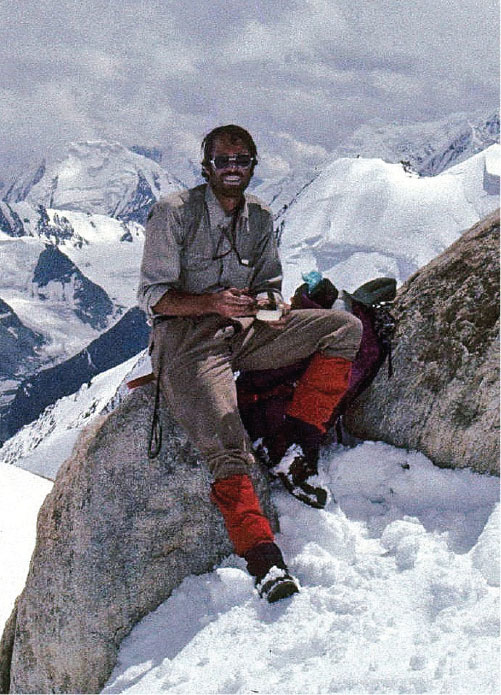
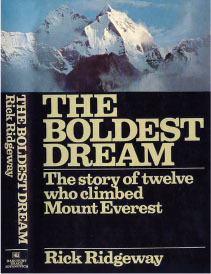
Reinhard’s journey is a study in extremes. As a young anthropologist, he was restless. He didn’t just study cultures from a distance—he immersed himself. Skydiving? That was just a means of accessing remote sites. Scuba diving? A tool for underwater archaeology. Rock climbing? Essential for reaching sacred peaks. In 1976, he joined the American Bicentennial Everest Expedition, when only two expeditions a year were allowed. He didn’t summit, but that was beside the point. The experience was a lesson in endurance, in knowing when to push forward and when to turn back. “The first team made it up but nearly died from the winds,” he recalls. “When they returned, the team voted to leave the mountain. I was disappointed I didn’t reach the summit, but given the number of Everest expeditions, you couldn’t pay me to climb it today.”
In the late 1980s, Reinhard directed the first underwater archaeological project in Lake Titicaca, Bolivia. He scuba dived in a lake at 19,200 feet in the summit of a volcano in Chile, a world record at the time. “It was almost a mile higher than had ever been dived before,” he says. He lived for more than 10 years in the Himalayas, and he was the first to study two of the world’s last nomadic hunting and gathering tribes, the Raute and the Kusunda. He found that the latter has a language unrelated to any of the world’s language families. And today it is the world’s rarest—only one speaker survives.
But after living outside of the United States for 27 years, he was ready to come back. He had met Taylor in Nepal decades prior and had kept in touch, so he reached out to ask for his advice. The next thing he knows, he has a house waiting in Franklin, West Virginia. “I’m from a town, New Lenox, Illinois, that had 800 people when I was born. And of course, all I wanted to do was escape. And here I am now in a town of 800 people.”
Reinhard has mastered the art of escape, but he is quick to point out that it has come at a cost. “I was tired. I was tired of second languages. I felt like a stranger wherever I went, even in the USA. For a time, I only spoke Nepali, I dreamt in Nepali. It’s a real contrast all of a sudden to be back in society and realizing that you don’t really know it anymore. Your cultural cues have been disrupted. I didn’t know how to get a ticket to the movies. I would go to the front of the line and listen to what people asked for because I didn’t know how to ask. Same thing at the grocery store. And that was before I had spent 10 years in the Andes! So when Daniel said, ‘I’ve got a house, if you pay the utilities.’ I thought, ‘Great. It’s not too far from Washington, D.C. I’ll stay for a year.’ That was 33 years ago, and I’m still here.”
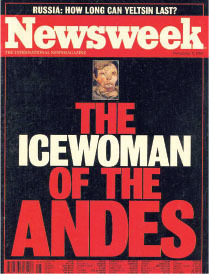
In fact, he was living in West Virginia when he discovered “Juanita,” the Ice Maiden, on Peru’s Mount Ampato, in 1995. “I wasn’t expecting to find something, but we were climbing along a narrow ridge that had partially collapsed when we noticed some color sticking out. It turned out to be the feathers of a headdress on a gold statue, and then we noticed a larger object lying in the open lower down. At first I thought it was a climber’s backpack. But when we got closer, we realized it was a mummy. The face was exposed, but the remainder of the mummy’s body was encased in frozen textiles. I knew we had to get her off the mountain, because she was exposed to the sun.”
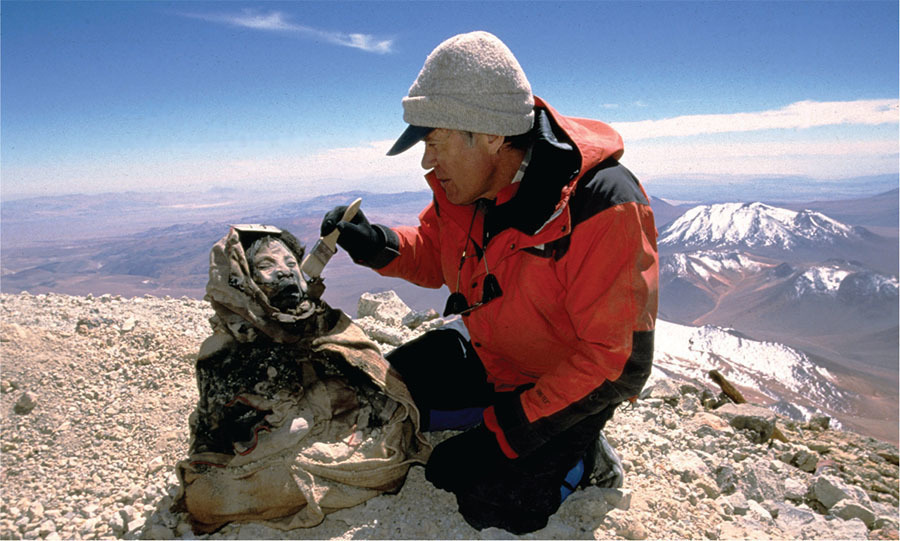
Descending more than 20,000 feet with a frozen mummy on your back is not for the faint of heart. As Reinhard and his assistant, Miguel Zarate, carried her down, they ensured she remained frozen and intact. She now rests in a specially designed chamber in Peru, where she is on display today. Juanita recently made news again when her face was reconstructed by Swedish artist Oscar Nilsson. “It’s amazing what technology can do today,” says Reinhard. “It makes these discoveries all the more exciting, because we will never stop learning from them.”
And Juanita wasn’t the only discovery. Between 1996 and 1999, Reinhard found 14 more Inca human sacrifices—including the three mummies on Mount Llullaillaco, the highest archaeological site on Earth. These mummies were so perfectly preserved that Time magazine named them one of the 10 most important scientific discoveries of the year. “With discoveries like these, scientists can look at DNA and even trace bacteria,” Reinhard says. “For example, you can trace 500 years of the mutations that have taken place in the bacteria, and it helps you prepare for any other kind of spin-offs.”
Reinhard’s approach is not just about digging up the past—it’s about preserving cultural heritage, respecting sacred landscapes, and ensuring that these discoveries remain accessible and meaningful to future generations. He says, “One of my biggest achievements that’s right up there with finding the frozen mummies is providing an explanation as to why the Incas were climbing to 22,000 feet. Nobody knew when I started in 1980. They said it must have been to get closer to the sun, the main deity of the Incas. And then I began finding out more about mountains and why they’re worshiped and how it ties in with the ecology and environment. This was a key to understanding their importance, and this is much the same all over the world. Inca human sacrifices aren’t what some people might think. They’re meant to be messengers to the gods. These are children, they were considered pure, and it was believed to be an honor to have been selected.”
And yet, for all the acclaim, the awards, the global recognition, Reinhard’s most unexpected moment of fame came in 2000, when People magazine named him one of America’s 100 Most Eligible Bachelors. George Clooney was on the cover, and there he was on page 107 next to Conan O’Brien and Mark McGwire. The town buzzed with speculation. “Word got out that someone from Franklin was chosen as one of People magazine’s 100 Most Eligible Bachelors, and no one could figure out who it was going to be. The women at the post office took bets. They thought it was our local funeral home director,” laughs Taylor.
The magazine said the reason he was still single was because he had “mummy issues.” “That was actually one of the most surprising things that ever happened to me,” says Reinhard. “It was wild. I received hundreds of emails and letters. Conan O’Brien even did a skit on his show about it. He said, ‘I finally made it into the People magazine’s Bachelor of the Year issue, and what did they do? They stick me beside a picture of this old fart.’”

From his quiet corner in West Virginia, Reinhard has been prolific. He has written more than 70 publications. If you watch the National Geographic channel, chances are you’ve seen him and his work—he is also an accomplished videographer and photographer. His research has been featured in several television documentaries, and he has won many awards, including the Rolex Award for Enterprise, the Puma de Oro—Bolivia’s highest award in the field of archaeology, and the Explorers Medal of the Explorers Club. He was also honored as one of the 25 most extraordinary explorers by Outside magazine and one of 12 Heroes for the Planet by Ford Motor Company.
Why, after decades of wandering, did he stay in Franklin? His answer is simple: Shangri-La, paradise on Earth. Something he has searched for the world over. “I can walk out my door and, within minutes, I’m climbing a hill, watching deer in a forest, and standing on a rock outcropping, looking over the whole valley,” he says. “This is a kind of Shangri-La. Truly. I have internet that keeps me connected to the world, and I still participate in expeditions. But I also have wonderful, friendly neighbors who understand where I’ve been. I can talk about Nepal or the Andes, and their eyes won’t glaze over. What more could you ask for?”
When Mountains Move You
Daniel Taylor was never interested in following the rules. He saw the world—not as it was, but as it could be. Where others saw broken systems, he built new ones. Where they saw limits, he created possibilities. And he didn’t do it from a position of power or privilege—he did it from a mountaintop in West Virginia.
There’s a lesson here. Maybe mountains are more than landscapes. Maybe the greatest discoveries happen when we choose to root ourselves in the places, the people, and the work that truly matters. That’s the legacy Taylor built—one that stretches from Appalachia to the Himalayas—proof that one person, rooted in purpose, can change the future.
West Virginia Scholars Academy
In the early 1980s, West Virginia had one of the lowest college attendance rates in the country. This was not, as some assumed, a reflection of ability or ambition. The problem was structural—an entire generation of bright, hardworking students cut off from opportunity, not because they lacked intelligence, but because they lacked access.
Daniel Taylor and his wife, Jennifer, who had helped start the Woodlands Mountain Institute, saw this as a solvable problem. He launched the West Virginia Scholars Academy, an experiment in educational mobility. The idea was simple: Select the state’s 100 most promising 11th graders—not just based on grades, but on grit—and connect them with top colleges across the country. These students would receive a preferential edge in admissions and full financial aid. But there was a second, equally important part of the model. Each selected student would mentor 20 others back home, creating a cascading effect that reached ultimately to ten thousand West Virginia high school students a year. The following is how all that started.
One day, Taylor received a call from a foundation executive in New Jersey. “I hear you’re doing interesting things in education,” the man said, “but I have a negative opinion about West Virginia.” Taylor didn’t flinch. “The problem isn’t the students,” he replied. “It’s the system that isolates them. If all that matters in college admissions is test scores, West Virginia students will lose every time. But if we create a relationship between students and colleges—if we change the metric—we change the outcome.” The executive asked what Taylor planned to do about it. Taylor asked how much he was willing to invest. The man offered $5,000 if Taylor could give him a plan in 60 days. Taylor told him to cut the check.
Over the following decade, the West Virginia Scholars Academy placed students in elite institutions at unprecedented rates—92% acceptance at Princeton, 94% at Harvard, 100% at Carnegie Mellon. West Virginia’s college-going rank in America rose from 49th to 46th.
For more information, visit future.edu, seed-scale.org, future.org, and johanreinhard.net.
READ MORE ARTICLES FROM WV LIVING’S SPRING 2025 ISSUE







Leave a Reply