









Lucas Sieber and Jaime Brown are bringing mushrooms to the masses, straight from their indoor farm to local farmers markets.
written by MATT KASSON
photographed by CARLA WITT FORD
Mushrooms are having a bit of a moment. West Virginia native Lucas Sieber, owner of Mon Valley Mushrooms in Morgantown, is thrilled the rest of us have finally taken notice. Sieber and his business partner, Jamie Brown, have spent the past three years cultivating a dream of providing locally grown mushrooms to customers around the Mon River Valley. Thanks to Sieber and Brown’s relentless hard work and unwavering enthusiasm, regional interest in fresh-market mushrooms is growing. Local hot spots like the Morgantown and Bridgeport farmers markets are buzzing with excitement and a diversity of fungal varieties.
“I think that one of the most rewarding parts of this job is getting to expose people to these wonderful organisms,” says Sieber, with a rack of newly emerging mushroom bags behind him. Brown agrees. “That’s something we are really happy about—being able to bring mushrooms to this area and diversify the food that people have access to.”

Just Getting Started
A native of Harrison County, Sieber grew up on a 70-acre farm outside the small town of Wyatt, spending most of his free time in the woods. Mushrooms were definitely present during the formative years he spent outside, but he never imagined himself becoming a mushroom farmer. Brown, a native of Greensburg, Pennsylvania, a small town southeast of Pittsburgh, recalls gardening and foraging morels from an early age. “Foraging was the beginning,” she says with a smile. Together, Brown and Sieber are now among just a handful of commercial mushroom producers in the Mountain State who are raising both awareness and excitement for fungi, one farmers market at a time.
Sieber first took up mushroom farming in the summer of 2017. At the time, he was buying fully colonized blocks online, and he had converted an old shed on his property to serve as a fruiting chamber where the mushrooms would develop and mature. He had a business license, although he’s quick to admit that he didn’t really have a well-developed plan. But all that changed after seeing the steady demand from Morgantown restaurants for his blue oyster and lion’s mane mushrooms. “I had awesome reception from local chefs, and that was kind of the inspiration for Mon Valley Mushrooms.”
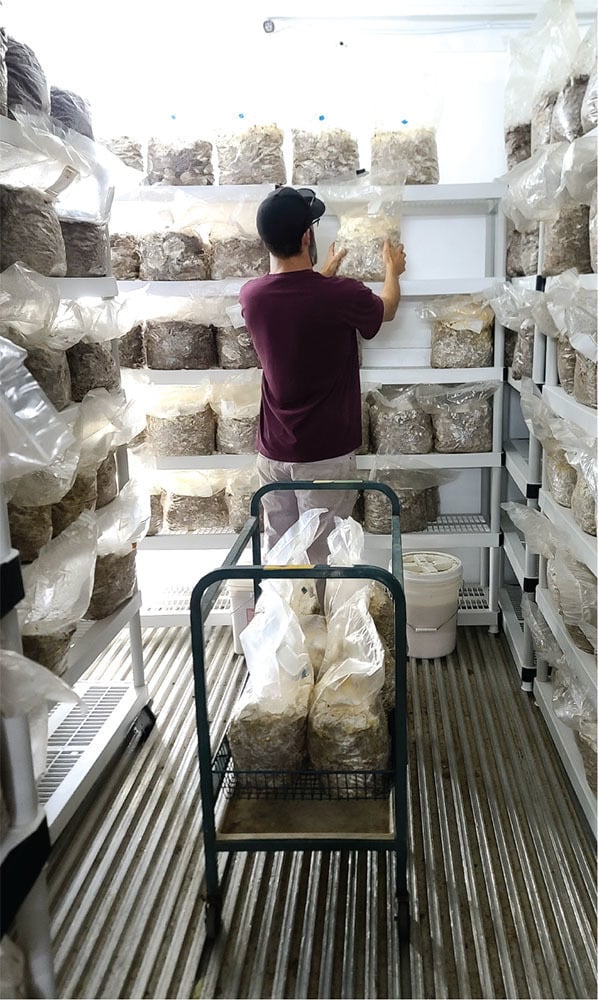
Sieber and Brown took a leap of faith in 2022, converting Sieber’s multi-bay garage into a legitimate operation complete with substrate sterilizer, flow hood for inoculating bags, and, eventually, a semi-automated bagging system that contains the wood pellet substrate upon which the mushrooms are grown. In 2024, they expanded their operation to include two custom tractor-trailers, specifically designed for mushroom cultivation, parked permanently adjacent to the garage workspace. This gave the two more space for mushroom fruiting, resulting in more product per week.
Since then, their business itself has mushroomed, with production inching closer and closer to 1,500 pounds per month— including not only fresh-market mushrooms but value-added products such as mushroombased meat rubs, seasoning salt, and teas, along with grow-at-home mushroom kits.
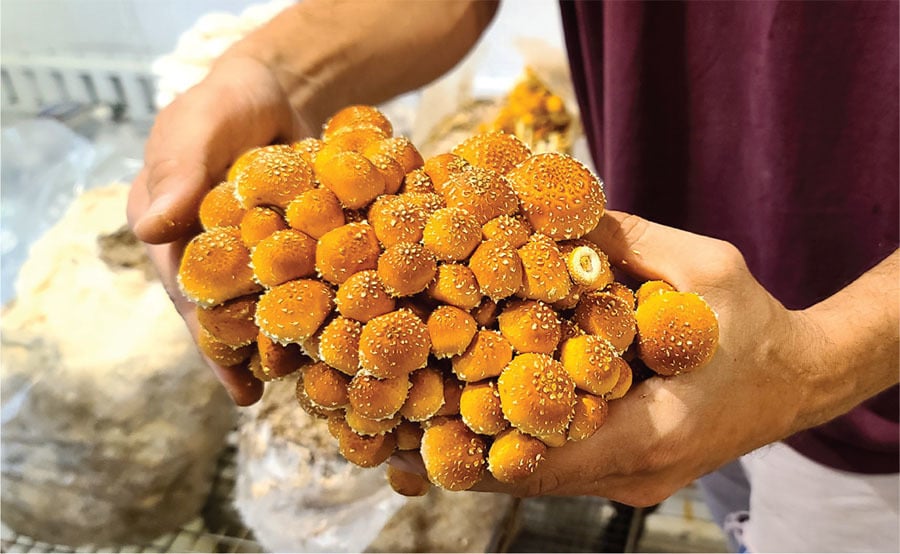
These combined products span more than a dozen mushroom varieties, including shiitake and chestnut mushrooms, lion’s mane, oyster mushrooms, enoki, reishi, and maitake. “I think diversification of our varieties and products is one of our strengths, even though some of our products aren’t as profitable as others,” Sieber says. To him and Brown, sometimes a loss is worth it. “We give a lot away to local food banks and give spent mushroom substrate to community gardens,” Brown adds. “Connecting with the community is the rewarding part.”
Down to Earth
Though both Brown and Sieber would love to see more people getting into mushroom production, they also caution about the not-so-glamorous side of mushroom business. “Everything we do up until market day is not cute,” says Brown. “I always tell folks when they come to volunteer, ‘It’s not rainbows and mushrooms and unicorns.’” Sieber flashes an exhausted smile. Both work grueling hours, often seven days a week, and acknowledge the help of several volunteers, without whom they’d never be able to step away.

At the start of every day, mushrooms are harvested. Sometimes it’s five pounds, sometimes it’s 20. Daily production and harvesting are necessary to meet the insatiable demands of a supply-limited industry. “We intentionally fruit for everything that we have so that, every market and delivery day, we have everything,” says Sieber. “Waves and waves of mushrooms.”
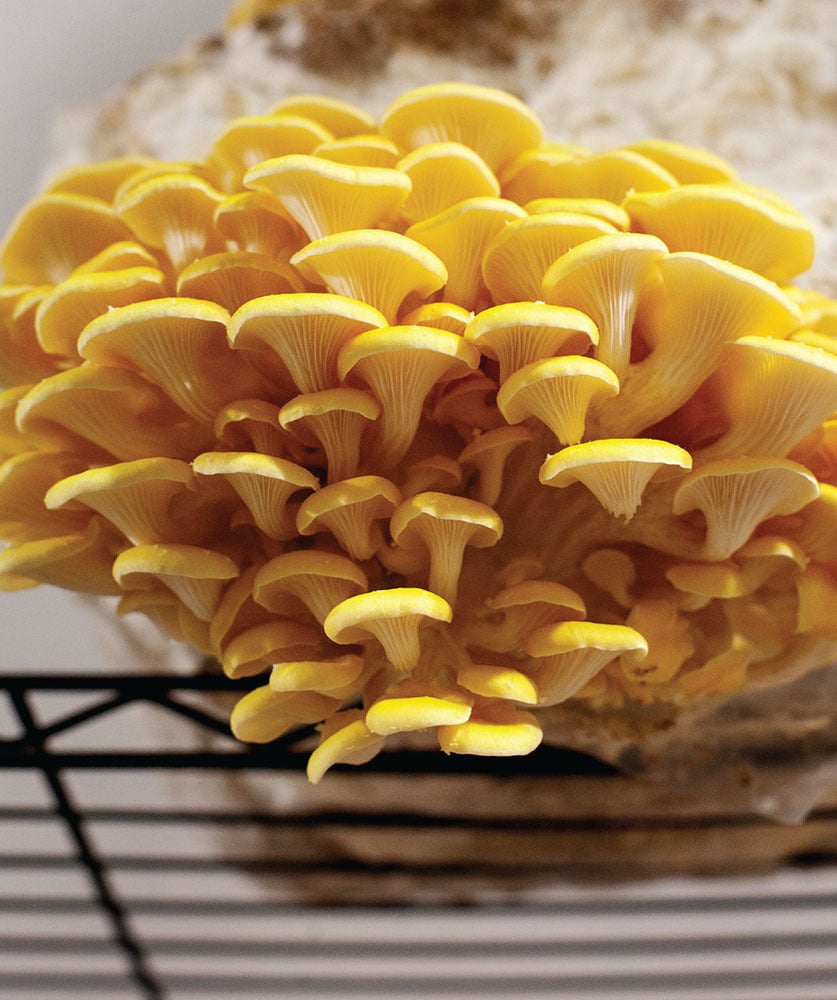
After three years, Mon Valley Mushrooms has grown into a mushroom-producing stalwart for the region. Sieber and Brown note growth in their customer base, and in their customers’ tastes as well. In their first year of business, Sieber estimates that nine out of 10 people had never seen a golden oyster mushroom or lion’s mane before. “The only people that knew what they were looking at were the chefs.” These days, even though 70% of their current customer base are new customers, they are coming equipped with more knowledge of fungi. Regulars routinely call ahead of weekend farmers markets to ask about the availability of chestnuts, enoki, and new tinctures or to make sure they get their shiitake mushrooms set aside. “People really like them,” says Brown. “You can tell they’re disappointed when we sell out before they get there or if we had a bad week and they were just a little bit behind.”
But Sieber says that giving consumers knowledge of how and where food grows as well as the barriers to its production is part of the process. “It creates more of an appreciation for things that people take for granted—including mushrooms.”
Morgantown, monvalleymushrooms.com, @monvalleymushrooms on IG
READ MORE ARTICLES FROM WV LIVING’S SUMMER 2025 ISSUE







Leave a Reply